
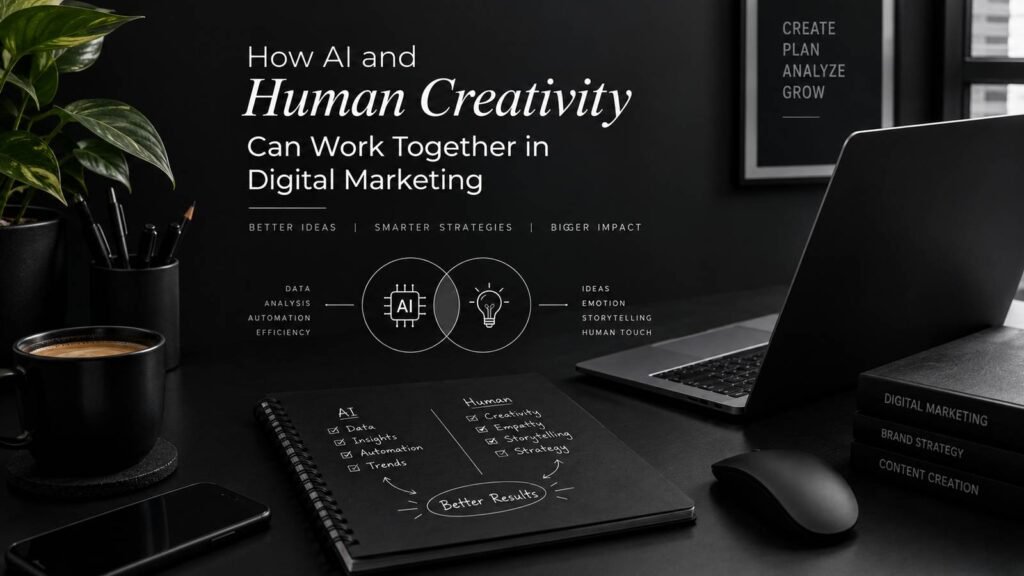
Digital marketing is changing quickly, and artificial intelligence (AI) has become an important part of this change. From creating content and analyzing customer behavior to improving advertising campaigns, AI is helping marketers work more efficiently. However, AI does not replace the ideas, emotions, and creativity that humans bring to marketing. The most effective approach is often to combine technology with human expertise.
Understanding the role of AI in digital marketing can help businesses and marketers use AI tools more effectively while keeping their marketing authentic and audience-focused.
The Impact of AI on Digital Marketing
The role of AI in digital marketing is to help marketers collect and analyze information, automate repetitive tasks, understand audiences, and make faster decisions. AI can process large amounts of data in a short time, helping marketers identify patterns that may be difficult to find manually.
For example, AI can analyze customer searches, website interactions, purchase behavior, and social media engagement. Marketers can then use these insights to create more relevant campaigns.
AI can support many areas of digital marketing, including:
- Search engine optimization (SEO)
- Content marketing
- Social media marketing
- Email marketing
- Paid advertising
- Customer service
- Data analysis
- Marketing automation
The role of AI in digital marketing is therefore not limited to one specific activity. It can support marketers throughout different stages of the customer journey.
How AI Supports Digital Marketers
One major benefit of AI is its ability to reduce the time spent on repetitive tasks. Digital marketers often work with large amounts of information, including keywords, customer data, campaign results, and content ideas.
AI can process and analyze this information much faster.For instance, marketers can use AI-powered tools to identify content topics, analyze keyword patterns, generate initial content ideas, or summarize campaign performance.
This practical application demonstrates the role of AI in digital marketing as a support system rather than simply an automated replacement for marketing professionals.
However, AI-generated suggestions still need human review. Marketers must check whether the information is accurate, relevant, and suitable for their target audience.
AI and Content Creation
Content is a key element of digital marketing, while AI helps create it more quickly. AI tools can help marketers brainstorm blog topics, create outlines, generate headlines, summarize information, and develop content ideas.
For example, a marketer planning a blog about SEO can use AI to generate possible subtopics and questions that customers may have. The marketer can then research those ideas and create an original article based on reliable information and personal expertise.
This is another important part of the role of AI in digital marketing. AI can assist with the early stages of content development, while humans remain responsible for the final message.
Good content should provide value rather than simply being produced quickly. Human marketers understand brand personality, audience emotions, cultural context, and communication style in ways that automated systems may not fully understand.
Why Human Creativity Still Matters
AI can generate ideas, but human creativity gives marketing its personality.
A successful campaign is not only about data or automation. It also needs an interesting concept, emotional connection, storytelling, and a clear understanding of the audience.
Human marketers can ask questions such as:
-
- What are the audience’s main interests?
-
- What emotion should the campaign create?
-
- Does this message match the brand?
-
- Is the content original and meaningful?
-
- Will people remember the campaign?
These decisions require judgment and creativity.
Therefore, the role of AI in digital marketing should be viewed alongside human expertise. AI can provide information and suggestions, while people can decide how those ideas should be used.
AI and SEO
SEO is another area where AI can support marketers. AI tools can help with keyword research, content planning, competitor analysis, search trends, and identifying potential content gaps.
For example, marketers may use AI to organize keywords around a particular topic. They can then create content that answers users’ questions and provides useful information.
The role of AI in digital marketing becomes especially useful when marketers need to analyze large amounts of SEO data. Instead of manually examining every piece of information, AI can help identify patterns and opportunities more efficiently.
However, SEO should not become an exercise in producing large amounts of automated content. Search-focused content still needs accuracy, originality, usefulness, and a clear purpose for the reader.
AI in Social Media Marketing
Social media marketers manage multiple platforms, content formats, audiences, and posting schedules. AI can simplify certain tasks.
For example, AI can assist with:
-
- Generating content ideas
-
- Creating captions
-
- Analyzing engagement patterns
-
- Identifying audience interests
-
- Suggesting content formats
-
- Supporting social media planning
The role of AI in digital marketing on social media is mainly to help marketers work more efficiently. But human creativity remains important when developing campaigns that reflect a brand’s personality.
A human marketer can also understand when a particular trend is appropriate for a brand and when it may not be suitable.
Personalization Through AI
Customers increasingly expect relevant experiences from brands. AI can analyze customer information and help marketers provide more personalized communication.
For example, an online store may use customer behavior to recommend products or send relevant email campaigns. AI can identify patterns in customer interactions and help businesses understand what different audiences may be interested in.
This shows another practical role of AI in digital marketing . supporting personalized customer experiences.
However, personalization should be handled responsibly. Businesses should respect privacy and use customer information appropriately.
AI + Human Creativity: A Better Partnership
The real opportunity may not be about choosing between AI and humans. Instead, marketers can combine the strengths of both.
AI is useful for:
-
- Speed
-
- Data analysis
-
- Automation
-
- Pattern recognition
-
- Repetitive tasks
-
- Idea generation
Humans are valuable for:
-
- Creativity
-
- Emotional understanding
-
- Strategic thinking
-
- Brand voice
-
- Critical judgment
-
- Original storytelling
When these strengths work together, marketers can spend less time on repetitive work and more time developing meaningful campaigns.
For example, AI could analyze customer behavior and suggest several content ideas. A human marketer could then select the most relevant idea, conduct research, add original insights, and create content that fits the brand.
This balanced approach demonstrates the broader role of AI in digital marketing while keeping human creativity at the center of communication.
Challenges of Using AI in Digital Marketing
Although AI offers many benefits, it also has certain limitations. AI-generated information can sometimes be inaccurate, outdated, repetitive, or lacking in context. Using AI without human review can therefore create problems for a brand.
Another challenge is originality. If businesses rely heavily on similar AI-generated ideas, their content may become less distinctive.
Marketers should also consider privacy, transparency, copyright, and responsible use of customer data.
Recognizing these limitations is essential for using the role of AI in digital marketing effectively. AI should assist marketers in making decisions rather than taking complete control of the process.
How Marketers Can Use AI Responsibly
Businesses can follow a few simple practices when using AI:
1. Review AI-generated content before publishing it.
2. Fact-check important information using reliable sources.
3. Add human experience and original insights to content.
4. Maintain a consistent brand voice.
5. Protect customer privacy when using marketing data.
6. Use AI for efficiency rather than replacing strategic thinking.
7. Monitor campaign performance and make improvements based on real results.
These practices help businesses get the benefits of AI while maintaining quality and trust.
The Future of AI and Human Creativity
The role of AI in digital marketing is likely to continue developing as technology becomes more advanced. AI may become more integrated into content creation, analytics, customer service, advertising, and marketing automation.
At the same time, human creativity will continue to play an important role. Brands need people who can understand customers, develop original ideas, tell compelling stories, and make strategic decisions.
The future of digital marketing may therefore be less about AI versus humans and more about AI working with humans.
Conclusion
The role of AI in digital marketing is expanding across SEO, content marketing, social media, advertising, analytics, and personalization. AI can help marketers save time, analyze information, automate repetitive tasks, and discover new opportunities.
However, technology alone cannot create meaningful marketing. Human creativity, experience, emotional understanding, and strategic thinking remain essential.
By combining AI’s ability to process information with human creativity and judgment, businesses can develop marketing strategies that are both efficient and authentic. The goal is not simply to use more AI, but to use it intelligently while keeping people at the heart of digital marketing